Sea Oil Public Company Limited recognizes the importance of conducting business with integrity and ethics, while upholding its responsibilities toward society and all stakeholder groups. The Company places significant importance on respecting human rights, which form a fundamental basis for sustainable business operations.
Accordingly, the Company has established a Human Rights Policy as a commitment to respect, support, and promote the protection of fundamental rights and human dignity for all individuals, including employees and stakeholders connected to the Company's operations. The policy is aligned with applicable laws and internationally recognized human rights principles, including the Universal Declaration of Human Rights (UDHR).
Through this commitment, the Company seeks to contribute to social responsibility and foster sustainable organizational development in accordance with its sustainability principles.
For additional information, please refer to the Company's website.
Targets and Performance
Targets
- Zero human rights violation complaints.
Performance in 2025
- Zero human rights violation complaints reported.
The Board of Directors, executives, and employees of the Company respect human dignity and are committed to treating all stakeholders fairly and equitably. The Company promotes equal opportunities for all and prohibits discrimination based on race, color, gender, age, religion, language, education, social status, disability, political opinion, or any other personal characteristics. The Company also adheres to applicable laws and internationally recognized human rights principles. To prevent human rights violations throughout its operations, the Company has established the following Human Rights Practices:
- Support and respect the protection of human rights and ensure that the Company's business activities and employees are not involved in any human rights violations, including forced labor, child labor, physical abuse, harassment, or any form of intimidation. The Company strictly complies with applicable labor protection laws and regulations.
- Respect internationally recognized employment principles and treat all stakeholders fairly by providing equal opportunities and preventing discrimination or violations of fundamental rights based on factors such as gender, age, religion, ethnicity, physical condition, political opinion, or any other status.
- Encourage subsidiaries, business partners, suppliers, and other stakeholders to adhere to internationally recognized human rights principles. The Company also provides appropriate remedies and protection to stakeholders who may be adversely affected by human rights violations resulting from the Company's business activities, in accordance with applicable laws.
- Provide a workplace environment that is conducive, accessible, safe, and supportive of employees' occupational health and well-being.
- Maintain grievance channels for reporting human rights concerns or violations related to the Company's operations, entities under its management control, and/or its supply chain through the Company's website at www.seaoilthailand.com.
- Implement measures to protect employees and individuals who report human rights violations, discrimination, or unfair treatment. Whistleblowers are protected fairly and confidentially in accordance with the Company's Code of Conduct and established whistleblower protection measures.
The Company conducts Human Rights Due Diligence (HRDD) in alignment with the United Nations Guiding Principles on Business and Human Rights (UNGPs) to identify, prevent, mitigate, and manage potential human rights impacts arising from its business operations. This process serves as a key mechanism for integrating human rights considerations into the Company's business practices and management approach.
The Human Rights Due Diligence process consists of the following five key steps:
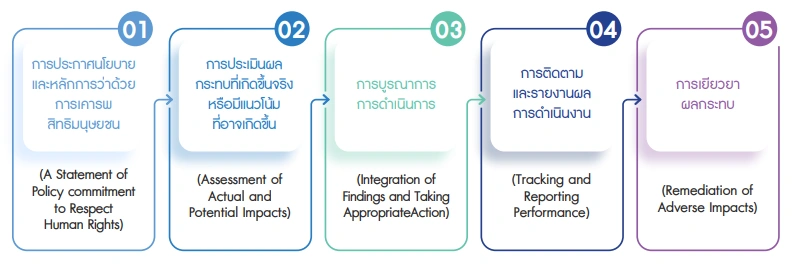
The Company has conducted a human rights risk assessment covering labor rights, community rights, health and safety, environmental impacts, and consumer rights across its value chain. The assessment identified several salient human rights risks that require close monitoring and the implementation of appropriate mitigation and control measures, including:
- Oil spill incidents during transportation operations.
- Misuse of customers' personal data beyond the intended purposes.
- Health and safety risks associated with employees working extended consecutive hours.
To address these risks, the Company has established measures and practices to prevent, control, and mitigate actual and potential adverse impacts. These include implementing the Zero Accident Program to reduce workplace accidents throughout operational processes, establishing policies and controls for personal data protection and customer confidentiality, and promoting employee well-being through the Happy Workplace Program, which supports both physical and mental health.
The Company provides channels for stakeholders to report concerns, complaints, or incidents relating to human rights violations associated with the Company's activities, entities under its management control, and/or its supply chain. Reports may be submitted through the following channels:
By Post
Chairman of the Board, Chairman of the Audit Committee, or Chief Executive Officer and President
Sea Oil Public Company Limited
88 Bangna-Trad Soi 30, Debaratna Road, Bangna Tai, Bangna, Bangkok 10260, Thailand
By Email
Chairman of the Audit Committee: ruth@banomyong.com
Chief Executive Officer and President: neeracha@seaoilthailand.com
Compliance and Company Secretary Office: compliance@seaoilthailand.com
Company Website
https://www.seaoilthailand.com/th/corporate-governance/declaration-of-anti-corruption
Complaints may be directed to:
- Chairman of the Audit Committee
- Chief Executive Officer and President
- Compliance and Company Secretary Office
The Company has established whistleblower protection measures for employees and individuals who report human rights violations, discrimination, or unfair treatment. Whistleblowers will be protected fairly, confidentially, and securely in accordance with the Company's Code of Conduct and established whistleblower protection procedures.
- To protect the rights of complainants and individuals who provide information in good faith, the Company will keep confidential the names, addresses, and any information that may identify the complainant or information provider. Such information will be securely maintained and accessible only to personnel responsible for investigating and handling the complaint. The Company will take appropriate measures to safeguard the complainant, information source, and related parties from potential harm or adverse consequences, except where disclosure is required for the Company's investigation process or by applicable laws.
- In cases involving complaints related to fraud or corruption committed by executives or senior management, the Audit Committee shall be responsible for protecting whistleblowers, complainants, witnesses, and individuals providing information during the investigation process from retaliation, harm, unfair treatment, or any adverse consequences resulting from their report, testimony, or cooperation.
- Personnel responsible for handling complaints are required to maintain the confidentiality of all complaint information, supporting documents, evidence, and the identities of complainants and information providers. Such information must not be disclosed to unauthorized persons unless disclosure is required by law.
- Individuals who suffer adverse impacts or damages arising from human rights violations, misconduct, or unfair treatment will be provided with appropriate and fair remedies through the Company's established grievance handling process.
1. Receipt of Reports and Fact Gathering
Upon receiving a whistleblowing report or complaint through the established channels, the designated recipient shall acknowledge receipt of the report to the whistleblower or complainant (where the individual has chosen to disclose their identity). Relevant facts and supporting information shall be collected and submitted to the Audit Committee within seven business days.
The Audit Committee shall assign the Internal Audit function or appoint a fact-finding committee, as appropriate, to conduct a preliminary review and investigation. Updates on the progress of the investigation shall be communicated periodically to the whistleblower or complainant, where applicable.
2. Investigation and Fact Verification
The assigned investigator or fact-finding committee shall be responsible for conducting the investigation, assessing the information received, evaluating potential impacts, and determining appropriate corrective and remedial actions for each case. The investigation results shall be reported to the Audit Committee for consideration within 90 business days. Any extension of the investigation period must be approved solely by the Chairman of the Audit Committee.
All investigators involved in the complaint review process must be independent and free from any conflict of interest relating to the matter under investigation.
Where an investigation indicates reasonable grounds to believe that the accused individual has engaged in fraud or corruption, the Company shall provide the accused with an opportunity to be informed of the allegations and to present additional information or evidence in support of their defense before a final determination is made.
3. Conclusion and Reporting
The assigned department, Internal Audit function, or fact-finding committee shall prepare a summary report covering all whistleblowing reports and complaints received by the Company and its subsidiaries.
Investigation findings, supporting evidence, and case progress shall be reported to the Audit Committee on a case-by-case basis. The Audit Committee shall subsequently report material matters and investigation outcomes to the Board of Directors for acknowledgement and oversight.