Sea Oil Public Company Limited recognizes that climate change is one of the most significant global challenges, affecting economic, social, environmental, and business sectors across all industries. This is particularly relevant to the energy and transportation sectors, which are closely associated with greenhouse gas (GHG) emissions. The Company is therefore committed to conducting its business responsibly with regard to climate-related impacts while supporting the transition to a low-carbon economy. This commitment is achieved through effective climate risk management, greenhouse gas emission reduction initiatives, the development of environmentally friendly products and services, and the creation of shared value for all stakeholder groups.
Targets and Performance
Targets
- Obtain verification and certification of the Carbon Footprint for Organization (CFO)
- Achieve Carbon Neutrality by 2030
- Achieve Net Zero Greenhouse Gas Emissions by 2050
Performance in 2025
- Successfully obtained verification and certification of the Carbon Footprint for Organization (CFO).
The Board of Directors recognizes the importance of conducting business responsibly while creating long-term value for all stakeholders. The Company is committed to driving sustainable growth through the systematic integration of Environmental, Social, and Governance (ESG) considerations into its business strategy, risk management processes, and corporate decision-making (ESG Integration).
To ensure effective sustainability governance and management, the Board of Directors has established a clear governance structure by appointing three sub-committees, namely the Audit and Risk Management Committee, the Nomination, Remuneration, Corporate Governance and Sustainable Development Committee, and the Executive Committee. These committees are responsible for overseeing, monitoring, and supporting the Company's operations to ensure compliance with principles of good governance, transparency, and sound corporate governance practices, thereby contributing to the Company's sustainable growth.
In this regard, the Board of Directors has delegated responsibility for overseeing and driving the Company's sustainability agenda, including climate change-related matters, to the Nomination, Remuneration, Corporate Governance and Sustainable Development Committee. The Committee is responsible for establishing sustainability policies, directions, and strategies, as well as continuously monitoring ESG performance and reporting the results to the Board of Directors. This enables informed strategic decision-making and promotes the achievement of tangible sustainability outcomes and performance improvements.
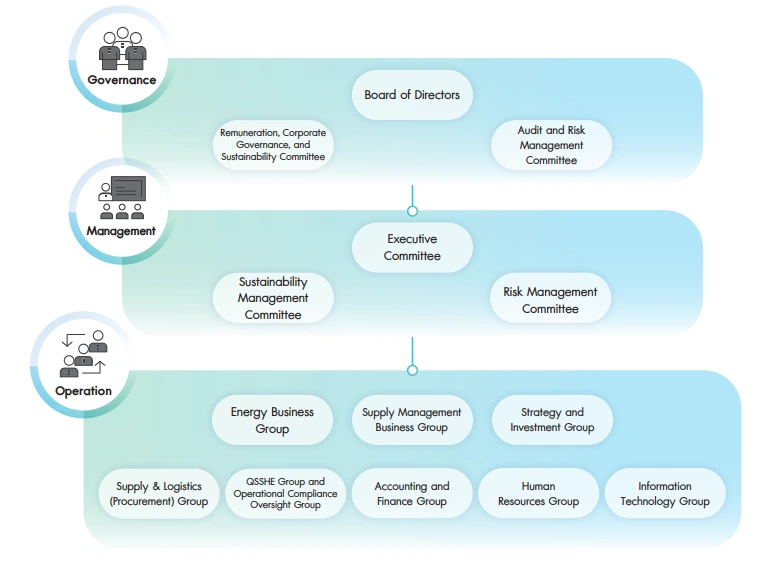
The Company has established a sustainability governance structure with clearly defined responsibilities at each level, as follows:
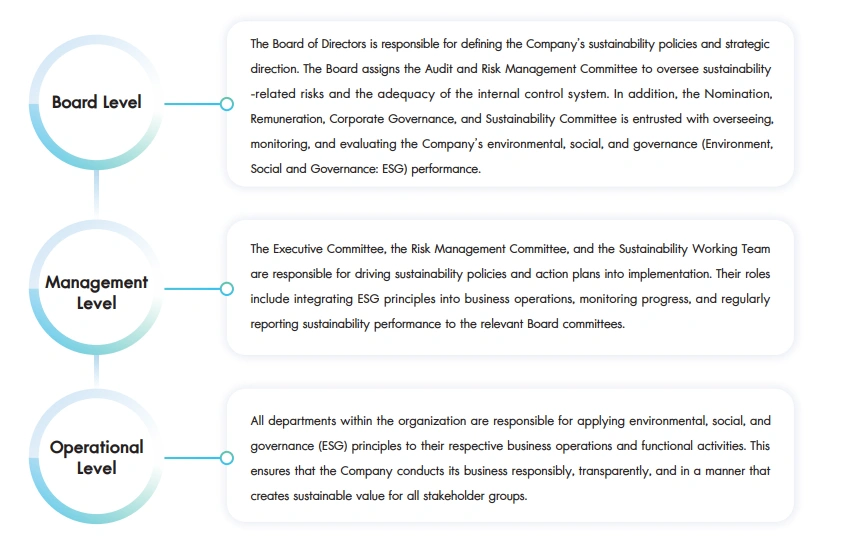
Note: Governance structure information as of 31 December 2025
Sea Oil Public Company Limited and subsidiaries (the "Group") recognize climate change as a critical global challenge with the potential to significantly impact economic, social, and environmental systems. The Group is committed to conducting business responsibly by promoting climate stewardship, sustainable natural resource management, and organizational resilience to climate-related impacts. To support these commitments, the Group has established the following principles and practices:
- Comply with applicable laws, regulations, policies, guidelines, and relevant standards relating to sustainable development and climate change management in all countries where the Group operates.
- Establish business goals, strategies, and operational approaches, while collaborating with suppliers and business partners throughout the value chain to reduce greenhouse gas emissions and support long-term climate adaptation.
- Identify, assess, and manage climate-related risks, opportunities, and impacts across the lifecycle of products and services, while systematically implementing measures to mitigate climate-related impacts, taking into account relevant stakeholders.
- Promote energy efficiency improvements across all business functions and encourage the development and adoption of technologies and innovations that reduce energy consumption and maximize resource efficiency.
- Implement sustainable procurement practices by prioritizing the selection of materials, products, and services with lower climate-related impacts.
- Communicate and raise awareness of climate change adaptation among employees, suppliers, and other stakeholders on a continuous basis.
- Support and collaborate with government agencies, educational institutions, communities, and other stakeholders in addressing climate change at both national and international levels.
- Develop Business Continuity Plans (BCP) and strengthen preparedness for natural disasters and emerging pandemics to ensure uninterrupted business operations.
- Monitor, control, and report greenhouse gas emissions from the Group's activities in accordance with internationally recognized standards.
- Disclose environmental and climate-related performance through sustainability reports and other relevant disclosures on an annual basis.
The Company integrates climate change considerations into its Enterprise Risk Management (ERM) framework to identify, assess, and manage potential impacts on business operations over the short, medium, and long term. Climate-related risks are assessed, reviewed, and reported to the Board of Directors on an annual basis.
The Company considers both physical and transition risks associated with climate change. Physical risks include natural disasters, extreme weather events, heavy rainfall, and flooding, which may affect operations, transportation activities, and supply chain continuity. Transition risks include changes in environmental laws and regulations, carbon pricing mechanisms, evolving customer and investor expectations, and the global transition toward cleaner energy sources.
At the same time, the Company recognizes opportunities arising from the growing demand for sustainable products and services, as well as the development of innovative technologies that help reduce environmental impacts and support long-term business growth.
The Company is committed to supporting greenhouse gas (GHG) emission reduction efforts and contributing to the transition toward a low-carbon economy through the following climate targets:
- Achieve Carbon Neutrality for Scope 1 and Scope 2 emissions by 2030
- Achieve Net Zero Emissions by 2050
- Establish 2024 as the base year for tracking and evaluating greenhouse gas performance
The Company will regularly review its targets and action plans to ensure alignment with business growth, energy transition trends, and relevant international standards.
Low-Carbon Transition
The Company places importance on developing products and services that contribute to climate change mitigation and meet customer needs during the energy transition.
The Company has obtained the International Sustainability and Carbon Certification (ISCC EU), which supports the trading of sustainable products and raw materials while enhancing confidence among customers and business partners throughout the supply chain.
In addition, the Company has collaborated in the development of biodegradable marine lubricants that naturally decompose in the environment, helping to reduce impacts on marine ecosystems and support more environmentally responsible business practices.
Further information is available under the "Innovation and Technology" section on the Company's website.
Greenhouse Gas Management
The Company recognizes that climate change and global warming are not merely environmental issues, but also have significant implications for the economy, society, quality of life, and the long-term sustainability of businesses. Therefore, the Company is committed to conducting business responsibly while enhancing resilience to climate-related risks and actively contributing to greenhouse gas emissions reduction.
The Company acknowledges that its operations involve the use of natural resources and may generate both direct and indirect greenhouse gas emissions throughout the value chain. As a result, the Company is committed to managing such impacts responsibly and continuously. The process begins with the assessment of the Company's Carbon Footprint for Organization (CFO) to gain a clear understanding of its emission sources and establish an appropriate foundation for emissions reduction initiatives.
The assessment identified significant greenhouse gas emissions sources within Scope 3, indicating that the Company's climate-related impacts extend beyond its direct operations and are linked to activities throughout the supply chain. The Company therefore utilizes this information to develop appropriate mitigation measures, support emissions reduction efforts, and contribute to a more sustainable business transition.
Greenhouse Gas Emissions Boundary
| Scope 1 | Scope 2 | Scope 3 *Significant |
|---|---|---|
| - Mobile combustion (fuel consumption from operations) - Fugitive emission (refrigerant leakage) - Methane leakage from septic tank systems |
- Electricity | - Category 1 Purchased goods and primary packaging materials - Category 15 Investments |
The Company's Carbon Footprint for Organization (CFO) was independently verified by VGREEN KU Co., Ltd., a verification body registered with the Thailand Greenhouse Gas Management Organization (Public Organization) (TGO), to ensure the accuracy, transparency, and reliability of the Company's greenhouse gas emissions data and to support systematic climate management.
In 2025, the Company expanded the scope of verification to cover all business segments, compared with the previous year when verification was limited to the oil trading business. The assessment was based on organizational activity data from 1 January to 31 December 2024 and was verified on 26 November 2025.
The Company has designated 2024 as its base year for monitoring, benchmarking, and evaluating future greenhouse gas performance summarized below:
Verified Greenhouse Gas Emissions
| Year | Verified Greenhouse Gas Emissions (tonCO2eq/year) | |||
|---|---|---|---|---|
| Scope 1 | Scope 2 | Scope 3 | Total | |
| 2024 | 213 | 104 | 115,045 | 115,359.64 |
| 2023* | 230 | 21 | 36,766 | 37,017 |
* Scope limited to the Oil Trading business.
In addition, the Company has been a member of the Thailand Carbon Neutral Network (TCNN) since 2023 and continues to maintain its membership to the present as a Climate Action Initiator, supporting collaboration in reducing greenhouse gas emissions and advancing the transition toward Carbon Neutrality and Net Zero Emissions.
The list of Thailand Carbon Neutral Network members is available at: https://tcnn.tgo.or.th/index.php?lang=EN&mod=ZEdOdWJnPT0¶m=TVE9PQ