Sea Oil Public Company Limited and its subsidiaries ("the Company") are committed to becoming a leading organization and trusted provider of integrated petroleum energy services, catering to the needs of customers both domestically and internationally. The Company conducts its business in accordance with the principles of good corporate governance, emphasizing transparency, fairness, and accountability while taking into consideration the interests of all stakeholders, including shareholders, employees, customers, business partners, creditors, as well as society and the environment. Guided by sustainable development principles, the Company strives to contribute to sustainable economic and social progress.
The Board of Directors recognizes the importance of good corporate governance and is committed to continuously enhancing and strengthening the Company's governance practices. The Board firmly believes that an effective corporate governance framework is a key factor in achieving sustainable business growth and long-term value creation.
To achieve these objectives, the Company has adopted the Corporate Governance Code for Listed Companies 2017 issued by the Securities and Exchange Commission of Thailand (SEC) and incorporates the assessment criteria of the Corporate Governance Report of Thai Listed Companies (CGR) established by the Thai Institute of Directors Association (IOD) into its governance practices. Furthermore, the Company aligns its governance framework and business ethics standards with internationally recognized sustainability and governance benchmarks, including the ASEAN CG Scorecard, the United Nations Sustainable Development Goals (SDGs), the Global Reporting Initiative (GRI) Standards, the SET ESG Rating, and the FTSE Russell ESG Ratings.
Targets and Performance
Targets
The Company received an “Excellent” rating in the Corporate Governance assessment conducted by the Thai Institute of Directors Association (Thai IOD).
Performance in 2025
The Company received an “Excellent” rating in the Corporate Governance assessment conducted by the Thai Institute of Directors Association (Thai IOD).
The Board of Directors has established comprehensive policies and practices covering corporate governance, sustainability development, the nomination and succession of directors and executives, and the Code of Business Conduct. These policies and practices are subject to regular review and annual revision to ensure their continued relevance and alignment with the Company's vision, mission, strategic objectives, and sustainability agenda, while also responding effectively to the evolving business landscape, regulatory developments, and stakeholder expectations. In addition, the Company regularly organizes training programs and seminars for directors, executives, and employees on Environmental, Social, and Governance (ESG) principles and sustainable business practices. The Company also communicates its Corporate Governance Policy, Sustainability Policy, and Code of Business Conduct to executives and employees at all levels to ensure awareness, understanding, and consistent implementation throughout the organization. These policies and guidelines are applied across all business units of the Company and its subsidiaries, both domestically and internationally, to foster a unified approach to governance and sustainability.
This enables directors, executives, and employees to consistently apply these principles in their daily operations and decision-making processes. The Company is committed to ensuring that all directors, executives, and employees possess a thorough understanding of applicable laws, regulations, internal policies, and ethical standards, and are able to perform their duties with integrity, accountability, and professionalism. This commitment supports the achievement of the Company's sustainability objectives, while creating long-term value for stakeholders and contributing positively to society.
For additional information on Corporate Governance Policy, please refer to the Company's website.
Remark
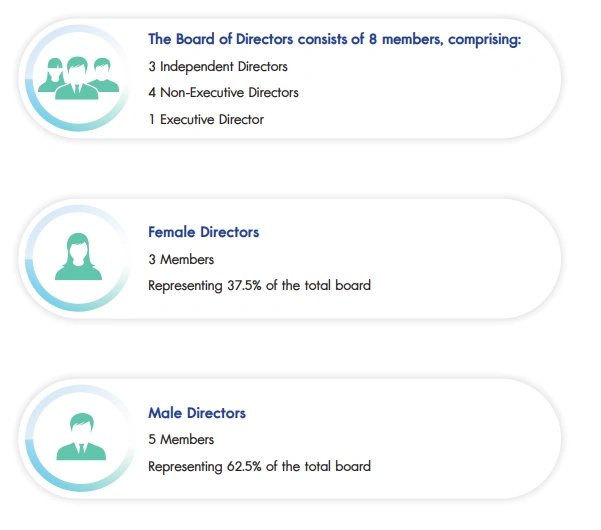
The Board of Directors comprises a total of eight directors, which is considered appropriate for the size and complexity of the Company's business operations. The Board consists of three independent directors, four non-executive directors, and one executive director, namely the President and Chief Executive Officer. As a result, seven directors, representing 88% of the total Board membership, are non-executive directors. The Company recognizes the importance of board diversity and is committed to promoting gender diversity at the Board level. As of 2025, the Board included three female directors, representing 37.5% of the total number of directors. The Board believes that diversity in terms of gender, knowledge, experience, expertise, and perspectives contributes to effective decision-making, enhances corporate governance practices, and supports the Company's sustainable growth.
In addition, the Company has established stringent qualifications for independent directors. Independent directors must not hold more than 0.5% of the total voting shares of the Company, its parent company, subsidiaries, associates, major shareholders, or controlling persons, including shares held by related persons of such independent directors. This shareholding threshold is more stringent than the requirements prescribed by the Capital Market Supervisory Board. The Company also maintains a clear separation between policy-making and management responsibilities to promote effective checks and balances and ensures sound corporate governance practices. Accordingly, the positions of Chairman of the Board and Chief Executive Officer and President are held by separate individuals. The roles, responsibilities, and authority of the Chairman of the Board and the Board of Directors are clearly defined in the Board Charter, ensuring effective oversight, independent judgment, and accountability in directing the Company's strategic objectives and long-term sustainable growth.
Sea Oil Public Company Limited ("Company"), The Board of Directors is responsible for providing leadership, strategic direction, and oversight to ensure that the Company operates in accordance with its vision, mission, and corporate objectives. The Board performs its duties with integrity, accountability, transparency, and due regard for the interests of all stakeholders, while promoting sustainable growth and long-term value creation. The Board's roles and responsibilities are clearly defined in the Board Charter and encompass, among others, the formulation of corporate strategy, oversight of management performance, risk management, internal control, corporate governance, sustainability development, and compliance with applicable laws, regulations, and ethical standards.
For additional information on the Board of Directors Charter, please refer to the Company's website.
In 2025, the Board of Directors assigned the Nomination, Remuneration, Corporate Governance and Sustainable Development Committee to review and update the Board Skills Matrix to ensure its alignment with the Company's strategic direction and the evolving business environment. Particular emphasis was placed on strengthening competencies in sustainability governance, risk and crisis management, organizational development, innovation, and technology, among other key areas. The review was undertaken to ensure that the Board collectively possesses the knowledge, skills, experience, and expertise necessary to effectively oversee the Company's operations, support sustainable growth, and address emerging opportunities and challenges in an increasingly dynamic business landscape. Details of the Board's collective competencies and areas of expertise are presented in the Board Skills Matrix below.
| Director Name | Energy, Petroleum and Petrochemical Industry | Service and Logistics Business | Law / Political Science | Accounting / Finance | Business Administration / Marketing / International Business | Engineering / Physics | Risk and Crisis Management | Organizational Development / Innovation / Technology | Corporate Communications | ESG |
|---|---|---|---|---|---|---|---|---|---|---|
| Mr. Apisit Rujikeatkamjorn | / | / | / | / | / | / | / | / | / | |
| Mr. Taweep Soonthornsigha | / | / | / | / | / | / | / | / | ||
| Prof. Dr. Ruth Banomyong | / | / | / | / | / | / | / | / | / | |
| Ms. Atchareeya Bansit | / | / | / | / | / | / | / | / | ||
| Mr. Suraphon Meesathien | / | / | / | / | / | / | / | / | / | / |
| Dr. Kosit Fuangswasdi | / | / | / | / | / | / | / | / | / | / |
| Ms. Neeracha Panboonhom | / | / | / | / | / | / | / | / | ||
| Ms. Laddawan Chooban | / | / | / | / | / | / |
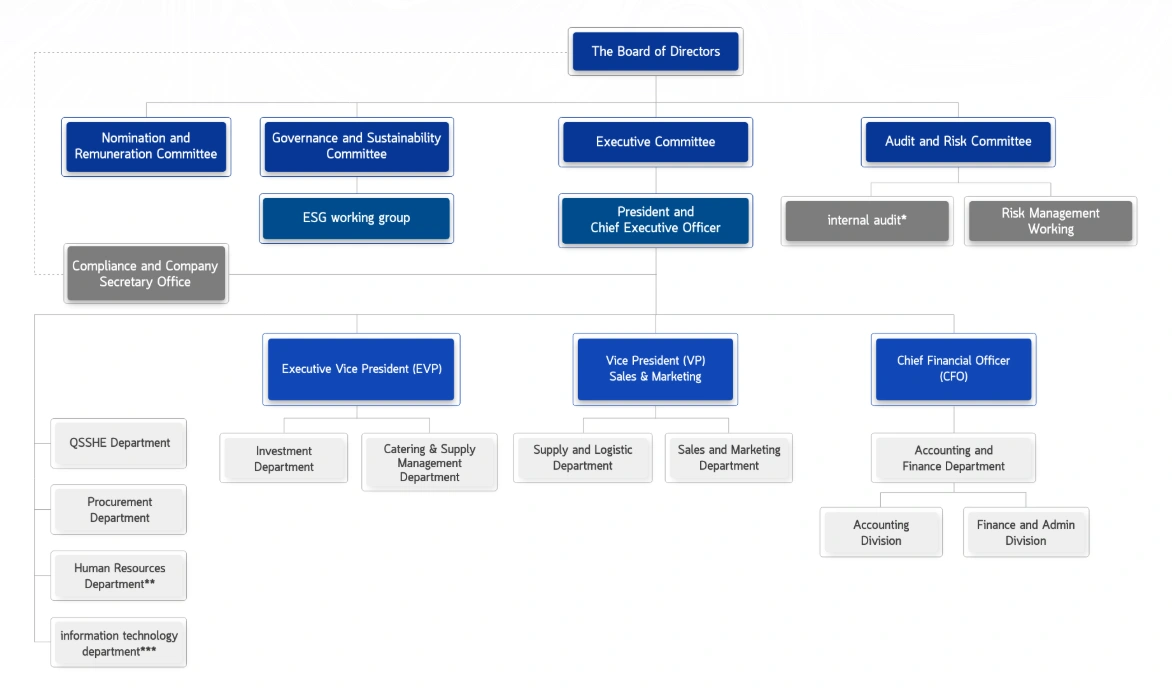
The Company has established three Board Committees to support the Board of Directors in carrying out its duties effectively and in accordance with good corporate governance principles. These committees comprise: Audit and Risk Management Committee, Nomination, Remuneration, Corporate Governance and Sustainable Development Committee and Executive Committee.
Board Independence from Management
The Company maintains a clear separation of responsibilities between the Board of Directors and management. The Board is responsible for establishing policies, setting the strategic direction, and overseeing and evaluating management's performance to ensure that the Company's policies, procedures, and operational practices are appropriate, effectively implemented, and aligned with the best interests of the Company and its stakeholders. To promote effective corporate governance and strengthen the system of checks and balances, the Company has clearly separated the roles of oversight and management. Accordingly, the positions of Chairman of the Board and President and Chief Executive Officer are held by different individuals. This governance structure enhances the independence of the Board and supports objective oversight of management's performance and decision-making by Mr. Apisit Rujikeatkamjorn Chairman of the Board is responsible for leading the Board of Directors and has clearly defined roles and responsibilities. These include convening Board meetings, ensuring that meetings are conducted efficiently and in compliance with the Company's regulations and Articles of Association, and fostering an environment in which directors are encouraged to express their views independently and openly.
The Chairman also monitors and supports the effective performance of the Board and its committees in accordance with their respective charters and the Company's principles of good corporate governance. Through effective leadership and oversight, the Chairman helps ensure that the Board operates efficiently, fulfills its responsibilities, and contributes to the achievement of the Company's strategic objectives and sustainable growth and Ms. Neeracha Panboonhom President and Chief Executive Officer is responsible for the day-to-day management of the Company and for overseeing its overall operations. The President and Chief Executive Officer is entrusted with implementing the policies, business strategies, objectives, operating plans, financial targets, and budgets approved by the Board of Directors.
In carrying out these responsibilities, the President and Chief Executive Officer provides leadership and direction to management and employees, ensuring that the Company's operations are conducted efficiently, effectively, and in alignment with the approved strategic framework. The President and Chief Executive Officer is also responsible for monitoring business performance, managing risks, optimizing resource allocation, and driving sustainable growth while creating long-term value for shareholders and other stakeholders.
Directorships of Directors and Executives in Other Companies
The Board of Directors has established guidelines regarding directorships held by directors in other companies. Directors may serve as directors of no more than five listed companies to ensure that they are able to devote sufficient time and attention to the performance of their duties and responsibilities to the Company. This limitation is intended to promote effective oversight and enable directors to discharge their responsibilities with due care, diligence, and efficiency, while ensuring adequate time commitment to the Company's business and governance matters.
If the President and Chief Executive Officer or any executive intends to accept an appointment as a director or executive in a non-listed company or another listed company that is not a subsidiary within Company's group, such appointment must be submitted to the Board of Directors for consideration and approval. In considering such appointments, the Board shall assess the appropriateness of the business nature of the external organization to ensure that it does not engage in a business of the same nature as or compete with the Company's business. The Board also considers whether the appointment may give rise to any conflict of interest or affect the individual's ability to effectively perform his or her duties and responsibilities to the Company. This requirement is intended to ensure that the Chief Executive Officer and President and senior executives are able to devote sufficient time and attention to the Company's affairs and continue to perform their duties effectively and in the best interests of the Company and its stakeholders.
The Company is committed to enhancing the continuous development of directors and executives by enhancing their knowledge, skills, and expertise in areas relevant to their roles and responsibilities. Key areas of development include directors' and executives' duties and responsibilities, corporate governance, sustainability development, enterprise risk management, and other topics essential to the Company's long-term success. The Board of Directors has established a formal orientation program for all newly appointed directors. The Company Secretary is responsible for coordinating the program to ensure that new directors gain a comprehensive understanding of their roles and responsibilities, the Company's business operations, shareholding structure, corporate governance policies, Code of Business Conduct, and applicable laws and regulations relevant to the Company's business. This orientation process helps prepare new directors to effectively discharge their duties and contribute to the Board's decision-making process from the outset. In addition, the Company implements executive development programs in conjunction with its succession planning framework to strengthen leadership capabilities and ensure the availability of qualified successors for key management positions. These initiatives support business continuity, leadership effectiveness, and the Company's sustainable growth objectives.
The Board of Directors has delegated the responsibility for reviewing the appropriateness of directors' and Board Committee members' remuneration to the Nomination, Remuneration, Corporate Governance and Sustainable Development Committee. The Committee reviews and recommends remuneration policies and remuneration packages in accordance with established principles and criteria before submitting them to the Board of Directors and subsequently to the shareholders' meeting for approval on an annual basis. The remuneration structure comprises both monetary and non-monetary benefits, including monthly remuneration, meeting allowances, performance-based remuneration, annual health check-up benefits, and health insurance coverage. The remuneration framework is designed to reflect the directors' qualifications, experience, knowledge, responsibilities, and contributions to the Company. In determining remuneration levels, the Company considers prevailing market practices and benchmarks against companies of comparable size and within similar industries to ensure that remuneration remains competitive, reasonable, and aligns with the Company's business objectives. The remuneration structure is also intended to attract, motivate, and retain qualified directors with the expertise and experience necessary to support effective governance and the Company's long-term sustainable growth.
The remuneration of the Chief Executive Officer and President and senior executives is determined in accordance with the Company's remuneration policy and established remuneration principles. The remuneration structure comprises salary, annual bonus, and long-term incentive compensation, and is designed to align with both the Company's performance and the individual performance of each executive. The Nomination, Remuneration, Corporate Governance and Sustainable Development Committee, which consists of independent directors and non-executive directors, conducts an annual performance evaluation of the President and Chief Executive Officer. The evaluation is based on mutually agreed performance criteria and key performance indicators that reflect the Company's strategic objectives, business performance, and leadership effectiveness. The results of the performance evaluation are submitted to the Board of Directors for consideration in determining the remuneration of the President and Chief Executive Officer. This process helps ensure that executive remuneration is fair, transparent, performance-based, and aligned with the interests of shareholders and the Company's long-term sustainable growth objectives.
The Board of Directors conducts annual performance evaluations to assess its effectiveness and identify opportunities for continuous improvement. The evaluation process enables the Board to collectively review its performance, consider challenges and areas for development, and establish appropriate measures to enhance its effectiveness in fulfilling its responsibilities. The Board undertakes performance evaluations of the Board as a whole and, where appropriate, specific aspects of its performance. The evaluation framework comprises the following three categories:
1) Board Performance Evaluation (collective self-assessment of the Board of Directors)
2) Individual Director Performance Evaluation
3) Board Committee Performance Evaluation (self-assessment of each Board Committee)
The Company has disclosed the results of the Board performance evaluations in its 2025 Annual Report (Form 56-1 One Report).
- The Company received an "Excellent CG Scoring" rating in the 2025 Corporate Governance Report of Thai Listed Companies (CGR) for the seventh consecutive year, as assessed by the Thai Institute of Directors Association (Thai IOD).
- The Company achieved a full score of 100 points in the 2025 Annual General Meeting (AGM) Quality Assessment Program (AGM Checklist), conducted by the Thai Investors Association.
- The Company regularly reviewed and updated its Authority Matrix to ensure alignment with its current business operations, organizational structure, and governance requirements.
- The Company successfully renewed its membership certification with the Thai Private Sector Collective Action Against Corruption (CAC) for the second consecutive certification cycle, reaffirming its commitment to conducting business with integrity, transparency, and accountability.
- The Company was recognized in the 2025 SET ESG Ratings and received an "A" rating, reflecting its commitment to environmental, social, and governance (ESG) practices and sustainable business development.
- The Company received the Outstanding Model Establishment Award for Occupational Safety, Health and Working Environment in 2025, recognizing its commitment to maintaining high standards of workplace safety and employee well-being.
- Throughout 2025, the Company received no complaints or reported incidents relating to legal violations, personal data breaches, fraud and corruption, or violations of the Code of Business Conduct.